Showing posts with label Brand. Show all posts

Wednesday, December 12, 2012

Underwear, the inside story

Not that I haven't experienced it, but with age, I think, we start appreciating smaller things in life more.

And I must say that there are only few things in life that can match the happiness that a new snugly fit underwear can provide. While trying to collect data for blog, I visited this wiki page on undergarments. I realized the depth and breadth, the science and art of that humble piece of clothing.

I shall not try to get into it and will stick to the happiness part that a newly bought trunks gave me and my realization of how I have been buying a product based on brand equity rather than the merits. Now as you have learnt from the wiki page, there are undergarment for every occasion. I have been a boxer person for a very long time now. but after I took up tennis, my undergarment shopping list included trunks as well. Never brief, the reason for which for my own sake I will never even briefly provide.


Jockey has always been the brand of choice for boxers and when my shopping list expanded for the other type, the choice followed. Though I have bought other brands like Hanes, Crocodile and Tantex, I usually would go back to Jockey. My mind was conditioned. Recently, due to convenience of a store located on the drive back home coupled with absence of a Jockey shop, I bought Poomer trunks for tennis. Like a child who likes to wear a new dress with much awaited eagerness, I tried Poomer the very next day for my game of tennis.

The product was remarkable and I found great comfort. That was the trigger, I became inquisitive. I wondered if it was because I was trying a new brand hence Jockey trunk didn't feel as great or actually Poomer was a better product. Then, I immediately bought a Jockey trunk so that the experience is fresh and I could do a real experiential experiment.

Results? I must say Poomer, which is as affordable as Jockey, is definitely a better product than my brand of choice for boxers.

And here is how Poomer scores over Jockey in the following categories:

  1. Price: At Rs. 150 and odd, the Jockey is slightly higher priced. But the difference is not too much. Actually, in my mind, I position Jockey to be more premium than Poomer. In fact I didn't expect the latter to be so highly priced.  
  2. Elastic: The elastic in Poomer is the traditional old model meaning you can see it with the brand name inscribed on it. Padded with cloth inside, it does provide great comfort and hugs the waist (a rather large one of mine) well. Jockey on the other hand is not so loud, the elastic is clothed on both sides. It is important because many brands do not have the insides padded which leave a very strong impression on the tummy and even hurts. But certainly, the hug of Poomer is far superior than Jockey. In fact, I found the latter to be little slag.  
  3. Comfort: The First Day Test can tell you a lot. If it gives you the best feel on day one, you can almost certainly be sure that it will feel good for a long time before diminishing returns sets in. You get this elated feeling, at least I get it with the good new one.
  4. Fit: The problem with Jockey was not only the waist but also the legging (for want of another word). Both the elastic top and bottom leg parts roll down and up, respectively. This often causes irritation and discomfort.
  5. Durability: I observed that in terms of life both brands last almost equally.
Isn't this a classic example of promotion over product. How a good product with promotion can be better positioned and how a better product without promotion may not achieve the same. Of course, I could be wrong. Maybe both the companies have clear segmentation strategy which is not clear to me.

Before I close, I thought I will register my quote here on this wonderful subject of "andar ka maamla"

Undergarments are like second skin, we shouldn't be aware of its presence. The moment we are reminded, it means there is a problem with it.

Sunday, April 03, 2011

Don't Take Social Media Seriously!

I do mean it. Companies should not take social media all that seriously!

Have I lost it? Just a couple of months back, I wrote that social media makes a great impact on the image of a company and consumers can make themselves heard quicker and be assured that they'll be responded to.

So, what has changed? Nothing. Social media continues to enjoy its status of the most powerful 'CRM' tool, today. Not only has it made companies listen to customers and respond to them faster, but it has impacted them on issues which could rather be classified as not in the 'public' domain. It has made GAP and Tropicana revert to their earlier brand avataars. Brands, really great ones, buckling under virtual pressure.

And I say nonsense!

First of all, despite being an MBA with specialization in Marketing and having worked in Communications industry for more than 10 years, I haven't quite figured out why does a logo need to be changed! Of course, many reasons are given, some meaningful while others shallow. More importantly, do companies imagine that they can change the market scenario just by changing their brand identity?

Abraham Chacko, my ex-colleague and friend, during our discussion on Airtel's new identity said that the company could have used the money more effectively by innovating and offering services to attract new customers and retain its existing base. Quite a valid point! Remember good packaging doesn't necessarily mean good product.

What it could have done is a different story. What it has done and how it will affect its position is to be seen. But what I do appreciate is that Airtel didn't buckle under the severe criticism that followed after it unveiled its new identity, unlike the others.

There's a story about the architect of the legendary Taj Mahal Hotel. Apparently, he threw himself overboard  because he found that though the hotel was built as per his design, the directions were changed! Not sure if the story is true, but am sure designers of GAP and Tropicana certainly would have felt more miserable.

Companies/Brands are taking social media far too seriously for their own good. You show disrespect not only to the consultant who (probably) has the right credential but also to your own self. Remember social media is just a part of the entire universe of customer audience for you. And most of the time, these social media netizens don't have the right credentials.


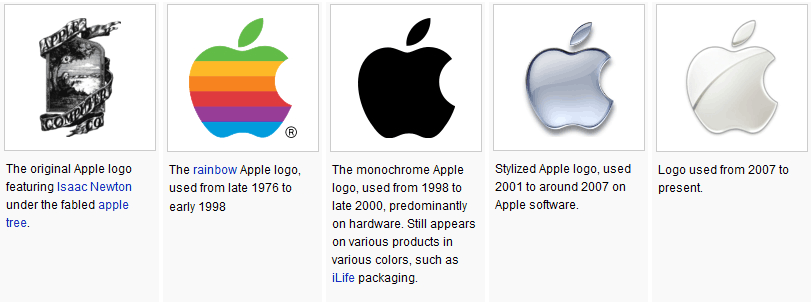
I am sure many of you would have heard the story about how Steve Jobs decided upon Apple as the brand name and how the logo came about. Can you imagine what the 'brand gurus' in social media would have said? 

Thank god, Steve Jobs didn't have to face 'experts' in social media.

Monday, May 03, 2010

Which Digital Camera Will I Buy?


If I had to buy a digital camera based on the ads being aired on Television, currently, I would buy the Canon IXUS.

In addition to Canon, Sony and Nikon are the other brands that are competing for your attention.

But as I said, IXUS' ad with two young ones driving on a highway is the best in terms of kindling interest. The ad communicates the key features like the touch screen, zoom, HD recording...I loved the part, where the lady moves from pillion to the front, like Rani Mukherjee in the movie Ghulam, while approaching a tunnel. Even the statutory warning line urging viewers not to perform the stunts performed in the ad has been used very creatively. The ad says, These actions have been performed by professionals, please don't try them but try the Canon IXUS. Nice!

Sony's ad featuring Deepika Padukone is also good. The ad moves in a fast pace with the lady walking the ramp and taking a 270 degree panorama picture of the audience. There is a slight snooty-ness about the ad but does capture attention.

Nikon ad is nothing to write about. Anyway, a guy gets caught taking pictures of a pretty one by the girl's father. The father checks the pictures in the camera and finds some good pictures and get impressed with the boy. Well, the ad doesn't impress at all.   

Monday, April 19, 2010

Chennai, What Is Your Identity?

So there was this Reliance Communications ad on the occasion of the company acquiring 100 mn customers. It was a Mario Miranda style cartoon of a crowded India with representation of various cities.

There was Qutub Minar, Gateway of India, Charminar...I looked for a sign of Chennai. And to my disappointment, there wasn't any sign of the city.
From a time when Chennai/Tamil Nadu represented the South, it is fast fading into oblivion. Bangalore is considered more cosmopolitan, and for housing IT companies, Hyderabad is also known for IT industry despite the fact that it lags behind Chennai and, of course, Kerala is "God's Own Country". In fact, I think Kerala has become the face of the South. At least the ad agency of SBI thinks so.

In terms of economy and culture, Tamil Nadu is far ahead than any other Southern state. But that it is the Detroit of India with Ford, Hyundai, BMW, Nissan, Mitsubishi, Ashok Leyland, Hindustan Motors, TVS, Caterpillar and many auto ancillary units are here doesn't seem to help. That Nokia, Samsung, Motorola and Foxconn are here doesn't count. That its Chola dynasty was a large empire dating much before the times of Mughal dynasty is forgotten. That some of the temples and architectures date back to BC is erased from the memory. Well, that is another story.
But then I pondered. If there was a face to Chennai, what was it? Every city has an identity. Paris - Eifel Tower, London - Big Ben/London Eye, Jaipur - Hawa Mahal, Kolkata - Howrah Bridge, Cochin-Jew Town...

Chennai?

Marina Beach? India has a large coastline. There won't be any differentiation. And let's admit, despite being the second largest beach in the world, Marine Drive in Mumbai has a better recall than Marina in Chennai.

Central Station? Maybe, but it is just a station. Rippon Building? Maybe, but I doubt if anybody outside Chennai knows about it.

St Thomas Mount or Santhome Church. There are so many churches in India, as old!

Factories - Ford, Hyundai, Nokia, Motorola...Nah!

Probably the answer lies in culture, history and religion. Hindu Temples? Which one? Kapaleeswarar, Parthasarathy? Probably. But do people outside Chennai know about them. Tanjore Big Temple! But that is about 300 km south. Mahabalipuram is also not exactly in Chennai.

Napier Bridge? But though it is distinct, it's a small structure.

Wish we could have done something while designing the new assembly complex. It is more contemporary and I don't think it is a structure that will get etched in the memory of Tamilians, themselves.

Now, I am confused more than ever. Or should I be happy that there are so many facets to this city?

PS: Did You Know (courtesy Deepak Chopra): What is the ABC of Chennai? Adyar, Buckingham and Cooum, the three rivers/canals in Chennai.

Monday, November 30, 2009

Apple Overtakes Nokia


Apple overtakes Nokia. Ok, Apple hasn't really overtaken Nokia in terms of units sold. But I guess that was never Apple’s intention.

By now, Apple's success has been well recorded and written about by media, marketing gurus/analysts, bloggers and authors.

So, I may not have anything new to say. But am recording my thoughts anyway.

When Apple announced the launch of iPhone, one of my colleagues wondered if the company would ever succeed and be able to beat the existing players. Mobile phone market is extremely crowded. We could very well say that mobile technology is definitely in the Tornado phase. There are Gorillas, Chimps and Monkeys. Oh, wait a minute. Mobile industry is actually commoditized market, meaning the switching costs are lower. So, we have King (Nokia), Prince(s) (Sony Ericsson, LG, Samsung...) and Serf(s) (anybody other than those previously mentioned).

It was a valid question. Apple, which has roots in computing, could be classified as Chimp in that industry. A specialist who could never win the battle against the IBM clones. But if there was one advantage that Apple had was its brand image. Apple was supposed to be cool. It was supposed to be a favorite brand of the famous. It was always aspirational. But because it defied the rules prescribed in Geoffrey Moore's Crossing the Chasm, it became a niche Chimp, trying hard to knock the pins in the alley.

But things were taking a different shape in the technology and consumer behavior. With the rapid innovations in the mobile handset and telecom industry, mobile phones were fast emerging, if not replacing PCs, as the mode for communication, computing and entertainment. Probably, it is the first true Convergence device. Today, there are more mobile-phones vis-à-vis the PCs and laptops.

Apple would have diminished and been wiped out if it had continued to stay in the PC industry. Despite bringing in newer technologies and being aspirational, lack of partners would have killed any chances of gaining dominance. And as it is said and shown in Pirates of Silicon Valley, Bill Gates and his Microsoft would have done a Fast Second.

I guess it was but natural for Apple to move into this space.

Oh btw, I very recently watched Pirates of the Silicon Valley. Do watch it, if you like Steve Jobs or Bill Gates or the PC industry.

Then something happened after the mercurial Jobs was back at the helm of affairs at Apple. He changed the fortunes for the company and waged a battle that has become a legend. And his weapon in this war – Apple’s brand equity.

This brand image not only bailed it out but also catapulted Apple to a leader in the new areas. Like a phoenix, it rose. While, everything that Jobs touched turned gold.

But we cannot say that brand image was the only reason for Apple to succeed. Philips is the best example which despite being associated with electronics industry could not cut ice in the handset industry, but it is not the only one example.

I think Apple made a strategic (conscious or unconscious) decision of first releasing iPod. Or maybe iPod happened and it was extended to iPhone.

Or I could say iPod set first the rules of the game and received an overwhelming response to its initiative to transition from desk and laps to the palm. While, the software and the iTunes did its magic, it was the show value of iPod which won the hearts and thus the desire amongst targeted users. As Naru would say the value is captured by what is visible and iPod, a sleek device, did a fantastic job. Apple with a slew of variants from Nano to Shuffle not only demonstrated dominance but also expanded market share.

Until Apple’s iPod arrived, the ubiquitous MP3 songs were heard mostly on computer. And, maybe on mobile phones. iPod revolutionized listening to music, the same way as Sony’s Walkman did, ages ago. Ah yes, Sony took the cue around the same time and launched Walkman series of mobile phones which also became popular. Later, the same series was rechristened W Series.

iPod had its own challenges. Microsoft launched Zune but failed miserably. Poor Microsoft, it has become so big and has to fight battles on so very many fronts.

Of course, other formidable challengers were Mobile handset companies themselves. Almost all built strong music features within them. Then, of course, other electronic players like Transcend, Creative, Samsung, Sony, and Philips…who brought their own music players. And not to forget, the unorganized/unbranded products, which were shells sold for peanuts.

There is a rule in technology marketing which says that the market leader has to continuously challenge itself. Which Apple did, pretty well.

Finally, an Apple product which retained its desirability quotient but transitioned Apple from a niche PC maker to a mass-market premium music player.


And it was this success and acceptability, which laid the foundation for the launch of iPhone. Now who could have imagined that Apple’s reincarnation? The biggest achievement for iPod was that it made Apple’s software be used by a much larger audience, something which weighed heavily against it in the PC market. What is important, it became the leader and rewrote the rules.

Persistence pays! Investing in brand repays more!

Thursday, May 21, 2009

Brand Name: How to name a product


For an initiative that we have undertaken at Congruent, my colleague and I met up with Mr. KR Chandrasekaran (Chandra), COO, Java Green, last weekend. We are building an IT product and sought Chandra's advice on how we should name the product.

After hearing our story and checking out the details, Chandra suggested a framework to work on. Chnadra opined that the brand name should ideally provide cues to what the product is likely to do for customers. This would help in easy association in the minds of customers, esp for brands that may not have a large advtg budget. He gave the example of Fair & Lovely and (at another level) Surf detergent. Surf surfs well (foams well). Of course, there are successful brands with names (like Nike or Accenture) that may have no direct meaning that consumers can associate with but they usually require significant time, effort & money to build.

He suggests that a brand name should preferably have 3 elements to it:

1. Name
2. A Category Descriptor
3. Benefit or tag line

He advised us to use Aaker's model, which provides an useful and practical approach to developing a brand's identity and helps to look at a brand in its entirety. He also strong suggested us to read Building Strong Brands by Mr. David A Aaker. I have added to the same to my wishlist.